

7 min read | First published: 2018 | Last updated: July 2026
Employee turnover remains one of the biggest challenges facing employers in China.
While job-hopping has long been a defining feature of the Chinese labour market, the motivations behind career moves have changed significantly over the past decade.
Today's employment landscape is shaped by slower economic growth, demographic change, digital transformation and increasing competition for specialised talent. Although employee mobility remains relatively high by international standards, professionals have become far more selective when considering new opportunities. Long-term career prospects, organisational stability and leadership quality increasingly outweigh short-term financial incentives.
For international companies operating in China, understanding these changing expectations is essential for attracting, retaining and developing high-performing employees and leadership talent.
Key Takeaways
- Competitive compensation remains important, but leadership and career development increasingly drive employee retention.
- Employer credibility and authentic recruitment communication have become significant competitive advantages.
- Talent mobility in China remains high, but professionals are becoming more selective when changing employers.
- Competition for experienced leadership talent continues despite moderating wage growth.
- Executive search is increasingly supporting succession planning, organisational transformation and leadership growth.
1.
Competitive Compensation Still Matters — But It Is No Longer Enough
For many years, salary was widely regarded as the primary reason employees changed jobs in China. While competitive compensation remains an important factor, today's professionals evaluate career opportunities much more holistically.
With salary growth moderating across much of the market, many employers are focusing their compensation budgets on high-performing employees and business-critical roles rather than applying uniform salary increases. At the same time, employees are increasingly looking beyond base salary. Career progression, meaningful work, learning opportunities and long-term professional development have become equally important when evaluating potential employers.
For employers, compensation should therefore be viewed as one element of a broader employee value proposition rather than the sole driver of attraction and retention. This broader approach is explored in our guide to Executive Compensation in China.
2.
Stability and Employer Reputation Have Become Competitive Advantages
China's labour market remains dynamic, but employee behaviour has changed noticeably in recent years. Rather than pursuing rapid career moves, many professionals now place greater emphasis on organisational stability, employer reputation and the long-term outlook of their employer. This trend is particularly visible among experienced managers, who tend to evaluate career opportunities more carefully than during the high-growth years before the pandemic.
Research also suggests that one of the strongest drivers of employee turnover is the gap between expectations created during the recruitment process and the reality employees experience after joining a company. When career opportunities, leadership style or corporate culture differ significantly from what was promised, trust erodes quickly and employees become far more likely to explore opportunities elsewhere.
Authenticity has therefore become an increasingly important aspect of employer branding. Companies that communicate openly and realistically during recruitment are generally better positioned to retain employees over the long term.
3.
Leadership and Career Development Are Key to Employee Retention
While compensation may attract candidates, effective leadership is often what convinces them to stay.
Today's professionals in China increasingly expect managers who provide clear direction, constructive feedback and opportunities for growth. Once basic financial expectations have been met, many employees place greater value on meaningful work, professional development, recognition and the opportunity to make a genuine contribution.
Organisations that invest in leadership development and transparent career progression typically experience higher employee engagement, lower voluntary turnover and stronger succession pipelines. In an increasingly competitive labour market, leadership quality has become a significant differentiator in attracting and retaining top talent.
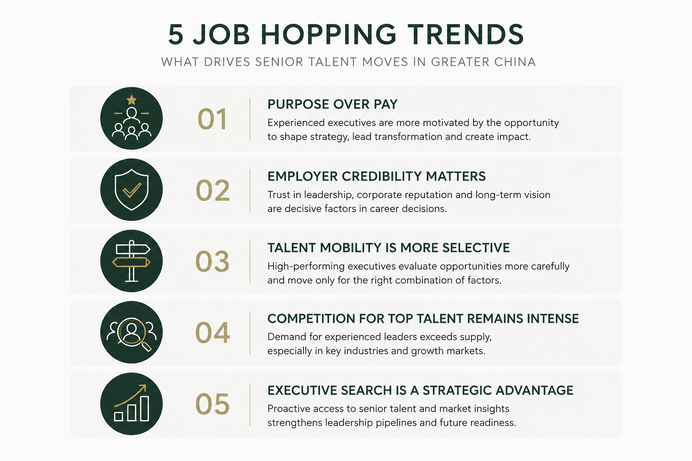
In our retained executive search assignments across Greater China, we frequently observe that senior executives rarely change employers solely because of compensation. Instead, they are attracted by opportunities to shape business strategy, lead organisational transformation and take on broader leadership responsibilities. For experienced leaders, the quality of the opportunity often matters more than the size of the salary increase.
4.
Talent Mobility Is No Longer Limited to Tier-1 Cities
For many years, Beijing and Shanghai were the undisputed centres of China's professional talent market. While both cities remain important business hubs, companies are increasingly building leadership teams and specialised functions in emerging cities such as Chengdu, Hangzhou, Suzhou, Nanjing and Wuhan.
These cities offer growing pools of highly qualified professionals, improving infrastructure and attractive living environments while often providing greater recruitment flexibility than the most established Tier-1 locations.
As a result, many international companies are moving away from a single-city hiring strategy towards a broader regional talent approach, allowing them to access specialised skills across multiple markets while strengthening their long-term workforce planning.
5.
Competition Is Increasing for High-Value Skills
Although overall salary growth has moderated, competition for specialised talent remains intense.
Companies continue to compete aggressively for professionals with expertise in digital transformation, artificial intelligence, advanced manufacturing, regulatory compliance and cross-functional leadership. These capabilities remain scarce despite a more cautious hiring environment, placing continued upward pressure on compensation for business-critical roles.
This shift highlights an important reality: China's labour market is no longer characterised by a shortage of workers in general, but by a shortage of professionals with the experience and leadership capabilities required to support business transformation and sustainable growth. Companies that identify and engage these individuals proactively will enjoy a significant competitive advantage.
What These Trends Mean for Employers
Job-hopping should not simply be viewed as an HR challenge. A certain level of employee mobility is a natural characteristic of a mature labour market, and changing employers can be a rational career decision for both professionals and organisations.
The companies that retain exceptional talent most successfully are those that look beyond compensation alone. Competitive salaries remain important, but long-term employee retention increasingly depends on effective leadership, realistic career opportunities, organisational credibility and an employee experience that matches the promises made during recruitment.
Ultimately, organisations cannot eliminate employee turnover. They can, however, create an environment in which high-performing professionals choose to build long-term careers. Companies that combine credible leadership, meaningful career development and proactive succession planning will be significantly better positioned to compete for talent in China's evolving labour market.
Executive Search as a Strategic Advantage
For many international companies, executive search is no longer simply a response to an unexpected resignation. Increasingly, leadership hiring is driven by succession planning, organisational transformation, localisation strategies and business expansion.
At Ginkgo Search Partners, we specialise in retained executive search for international companies across Greater China. With more than 15 years of executive search experience in China, we help clients identify, assess and attract senior executives for strategically important leadership positions. Whether supporting confidential succession planning, replacing a key executive or building an entirely new leadership team, our objective is always the same: helping clients secure leaders who create lasting business impact.
Looking to strengthen your leadership team in China? Contact our executive search consultants to discuss your hiring requirements.
Related Executive Insights
Executive Search for Senior Leadership Positions in China
Executive Compensation in China: A Guide for International Companies
The Hidden Benefits of Retained Executive Search
Competing for Executive Talent in China: Strategies for International Companies
