

7 min read
Last updated: June 30, 2026
LinkedIn has become the leading platform for executive recruiters to identify and engage senior leadership talent. Whether you are actively exploring new opportunities or simply open to confidential conversations, an optimized LinkedIn profile can significantly increase your visibility.
For executive recruiters, LinkedIn is often the starting point for identifying leadership talent. The following recommendations will help you optimize your profile and increase your visibility.
Optimized LinkedIn Profile
Example profile of a Managing Director in China.
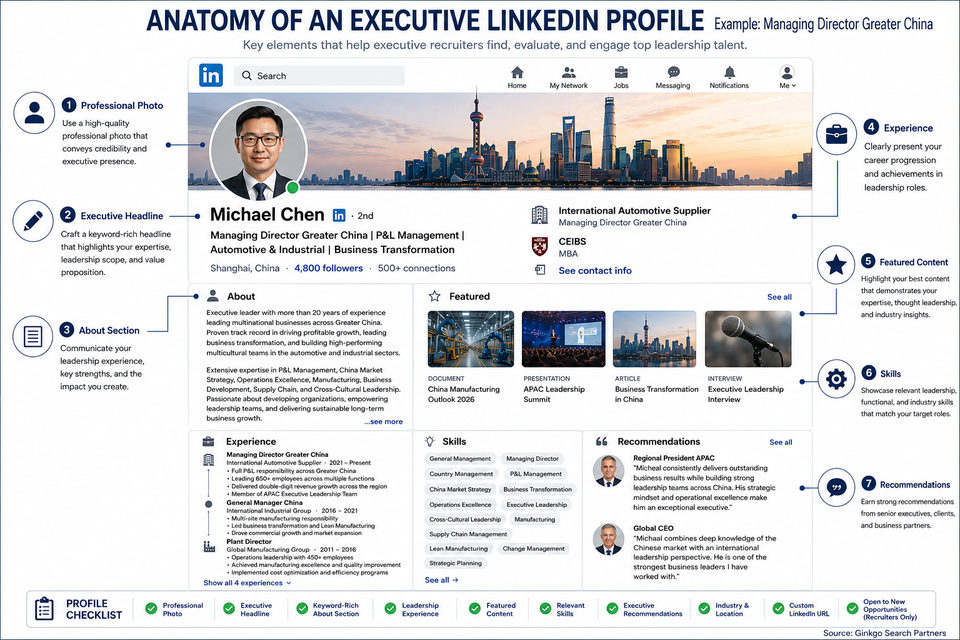
Show Up in Searches
Even the strongest executive profile has little value if an executive recruiter cannot find it. Optimizing your LinkedIn profile with relevant industry, functional, and leadership keywords improves your visibility in LinkedIn searches. Use keywords that accurately reflect your expertise, responsibilities, and target roles, and naturally incorporate them throughout your headline, About section, experience, and skills.
Executive recruiters are also more likely to engage with leaders whose profiles are complete, up to date, and present a consistent career story. A well-maintained profile signals professionalism and credibility.
Your professional network also plays an important role. Rather than focusing on the number of connections, build meaningful relationships with industry peers, senior executives, and executive recruiters to strengthen your visibility and professional presence on LinkedIn.
Use a Professional Profile Picture
Your profile photo is often the first thing an executive recruiter notices when reviewing your LinkedIn profile. A recent, high-quality professional headshot creates a strong first impression and reinforces your credibility as a leader. Choose a photo that reflects the level of executive positions you are targeting.
Avoid casual snapshots, vacation photos, selfies, or images with distracting backgrounds. Your profile picture should be well-lit, high-resolution, and professionally presented. A polished headshot helps communicate confidence, professionalism, and executive presence—qualities that executive recruiters look for when identifying leadership talent.
Be Up to Date and Stay Active
Once an executive recruiter has visited your profile, make sure it is up to date, accurate, and reflects your current leadership responsibilities. Beyond your profile photo and headline, the About section is one of the first areas recruiters review to understand your experience and career progression.
Use the About section to highlight your leadership experience, key achievements, areas of expertise, and the value you have created for organizations. Rather than repeating your résumé, focus on what differentiates you as a leader and the impact you have made throughout your career.
If your job title does not clearly reflect your level of responsibility, briefly explain your reporting line, geographic scope, team size, or P&L responsibility. This helps executive recruiters quickly assess the scale of your leadership experience.
An active LinkedIn presence can further strengthen your professional brand. Sharing industry insights, commenting on relevant discussions, and occasionally publishing your own content demonstrates thought leadership and keeps your profile visible to your professional network and executive recruiters.
Whenever possible, highlight measurable achievements rather than simply listing responsibilities. Quantifiable business results help executive recruiters better understand the scope and impact of your leadership.
Include Your Location

Your location is an important part of your LinkedIn profile. Executive recruiters often use location filters when searching for leadership candidates, making it easier to identify executives who are based in or willing to relocate to a specific market.
Keeping your location up to date increases your visibility in recruiter searches and helps ensure that you are considered for relevant executive opportunities. If you are open to relocation or international assignments, make this clear in your profile or preferences to broaden your career opportunities.
Display Your Educational Background
A complete education section makes your LinkedIn profile more credible and improves its visibility in recruiter searches. It also helps executive recruiters better understand your academic background, professional development, and career progression.
Include your degrees, universities, executive education, and relevant professional certifications where appropriate. A well-maintained education section also makes it easier for former classmates, hiring managers, and executive recruiters to find and connect with you.
Indicate Your Industry
Selecting the right industry helps executive recruiters identify your profile more easily when searching for leadership candidates. It also provides valuable context about your background and ensures that your profile appears in more relevant recruiter searches.
Choose the industry that best reflects your current executive experience rather than the sector you would like to enter. This improves the accuracy of LinkedIn's recommendations and increases your visibility to executive recruiters looking for leaders with your specific industry expertise.
Display Your Current Position
Keeping your current position up to date signals professionalism and ensures that executive recruiters can accurately assess your career progression, leadership responsibilities, and current scope of work. An outdated profile may create unnecessary uncertainty during the initial screening process.
Make sure your LinkedIn profile reflects your current company, job title, start date, and key responsibilities. A well-maintained profile demonstrates attention to detail and makes it easier for executive recruiters to evaluate your experience for relevant leadership opportunities.
Avoid leaving long unexplained career gaps or outdated positions, as executive recruiters may interpret these as potential red flags during an initial review.
Showcase Relevant Skills
Skills are an important ranking factor within LinkedIn's search algorithm and help executive recruiters quickly understand your areas of expertise. Focus on leadership, functional, and industry-specific skills that align with your target executive roles. Prioritize quality over quantity by selecting the skills that best represent your executive profile.
Where appropriate, ask trusted colleagues or business partners to endorse your most relevant skills, reinforcing your professional credibility.
Use the Featured Section
Your Featured section is one of the first areas recruiters notice after reading your profile summary. Use it to highlight your most valuable professional content, such as published articles, presentations, interviews, case studies, podcasts, or media appearances.
A carefully curated Featured section allows executive recruiters to evaluate your expertise, communication style, and thought leadership beyond your career history.
Request Recommendations
Recommendations provide independent validation of your professional achievements and leadership style. Unlike self-written profile content, they demonstrate how colleagues, clients, supervisors, or business partners perceive your contribution.
A small number of high-quality recommendations from senior executives, clients, or board members is often more valuable than dozens of generic endorsements. Strong recommendations significantly increase your professional credibility.
Publish Industry Insights
Regularly sharing valuable insights helps establish your professional reputation and demonstrates subject matter expertise. Publishing articles or commenting on industry developments keeps your profile active and increases your visibility within your professional network.
Consistently creating valuable content helps build your executive presence and personal brand. By sharing leadership perspectives, market insights, business achievements, and industry expertise, you position yourself as a trusted authority rather than simply another executive with an online profile.
Executive recruiters increasingly evaluate candidates not only on their career history but also on their thought leadership. Consistently publishing insights on leadership, industry trends, or market developments strengthens your personal brand and makes your profile more memorable.
Build Relationships with Executive Recruiters
Optimizing your LinkedIn profile is only the first step. Building relationships with executive recruiters before you actively enter the job market can significantly increase your visibility for future leadership opportunities.
Many senior executives are reluctant to engage with executive recruiters because they worry about confidentiality or sending the wrong signal to their current employer. In reality, executive search firms regularly approach passive candidates for confidential leadership assignments, making it worthwhile to maintain an up-to-date profile and a professional online presence.
If you are open to exploring new opportunities, use LinkedIn's career preferences to indicate your interest confidentially and connect with a small number of reputable executive recruiters in your industry. Rather than contacting recruiters only when you need a new role, invest in building long-term professional relationships. The strongest executive search partnerships are often established well before the next career move.
Engaging with executive recruiters, industry peers, and business leaders through thoughtful discussions strengthens your executive presence and expands your professional network. Remember that executive recruiters value long-term professional relationships. Even if you are not actively looking for a new role, maintaining an open dialogue can lead to future leadership opportunities.
Finally, customize your LinkedIn profile URL to create a clean, professional web address that is easier to share on business cards, email signatures, resumes, and personal websites. While it may seem like a small detail, it contributes to a polished executive brand.
Note: Although LinkedIn discontinued its localized service in mainland China, it remains one of the most important platforms for international executive search. A strong LinkedIn profile continues to be highly recommended for executives pursuing leadership opportunities in China.
Looking to explore executive career opportunities in China? Join our Executive Gateway to confidentially submit your CV and become part of our network of senior executives considered for retained executive search assignments throughout Greater China.
RELATED INSIGHTS
