
9 min read | First published: July 2026
China's industrial sector is entering a new phase of transformation.
Digital manufacturing, artificial intelligence, robotics, industrial software and increasingly sophisticated domestic technology companies are reshaping the competitive landscape. Much has been written about these technological developments. Far less attention has been given to an equally significant consequence: the changing profile of industrial leadership.
For international companies operating in China, manufacturing transformation is no longer simply an operational challenge—it is a leadership challenge.
As industrial businesses become more digital, connected and innovation-driven, executives must integrate engineering, software, commercial strategy and organisational change while competing in one of the world's most dynamic industrial markets.
The question is no longer whether manufacturing is changing. It is whether leadership is changing fast enough.
China's Industrial Transformation Is Accelerating
China has evolved far beyond its historic role as the world's manufacturing centre. Today, it is increasingly becoming a source of industrial innovation.
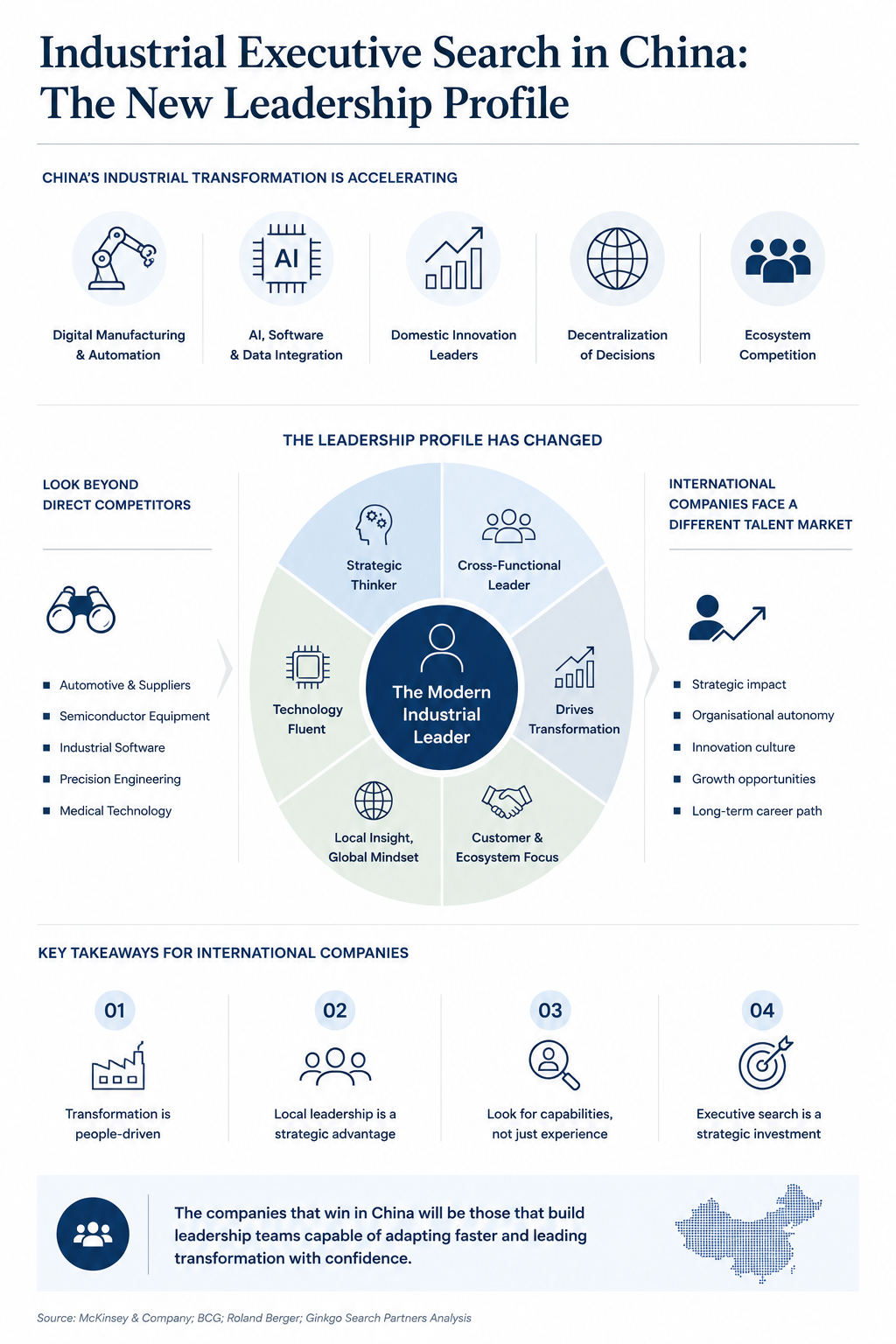
Across sectors including industrial automation, robotics, automotive, battery technology, semiconductor equipment and advanced manufacturing, Chinese companies continue to move up the value chain. Domestic manufacturers are investing heavily in digital production, intelligent factories and AI-enabled manufacturing systems, while international companies are simultaneously expanding engineering capabilities and regional decision-making within China.
The result is a far more competitive industrial ecosystem than many multinational companies experienced even five years ago.
Competition is no longer defined primarily by manufacturing cost or production capacity. Increasingly, it is determined by innovation speed, customer proximity, software capabilities and organisational agility.
These changes fundamentally alter what successful leadership looks like.
The Leadership Profile Has Changed
Historically, industrial companies recruited leaders primarily for their technical expertise and operational excellence. A successful General Manager was expected to optimise manufacturing, improve efficiency and manage increasingly complex production environments. Those capabilities remain essential—but they are no longer enough.
As China's industrial sector continues to evolve towards more intelligent, connected and innovation-driven business models, leadership expectations have fundamentally changed. Industrial companies are no longer building products alone; they are developing integrated solutions that combine hardware, software, data and services. This transformation requires a different type of executive.
Today's General Managers lead technology-driven organisations rather than traditional manufacturing businesses. Engineering leaders oversee multidisciplinary teams spanning mechanical engineering, electronics, software and automation. Operations executives must integrate digital technologies while maintaining operational excellence, and commercial leaders are expected to understand customer applications, industrial ecosystems and long-term strategic partnerships rather than product sales alone.
The result is a broader and more demanding leadership profile. Technical expertise remains an important foundation, but it is increasingly complemented by strategic thinking, organisational transformation, cross-functional leadership and the ability to build high-performing teams in rapidly evolving markets.
Industrial leadership has evolved beyond managing factories. It is now about leading innovation, transformation and sustainable business growth.
Looking Beyond Direct Competitors
One of the most common assumptions in executive search is that the strongest candidates come from direct competitors. In reality, limiting the search to the obvious talent pool often means overlooking exceptional leaders.
Many of the most successful executives we identify have built their careers in adjacent industries facing similar technological and organisational challenges. Leaders from automotive suppliers, semiconductor equipment, industrial software, precision engineering or medical technology companies often bring highly transferable experience in managing complex engineering organisations, driving innovation and leading business transformation.
For international companies, the ability to navigate technological change, build high-performing teams and execute strategy in a fast-moving market is typically far more valuable than deep product expertise alone. Product knowledge can be acquired; leadership capability is far more difficult to develop. We increasingly observe that clients who broaden the candidate pool identify stronger leadership talent.
The most successful executive searches therefore begin with a broader perspective. Rather than focusing exclusively on direct competitors, they identify leaders with the capabilities to shape the future of the business—not simply those who understand its past.
International Companies Face a Different Talent Market
The executive talent market in China has become significantly more competitive. International companies no longer compete solely with other multinational organisations, but increasingly with ambitious Chinese industrial technology companies that offer experienced executives greater organisational influence, faster decision-making and strong growth opportunities.
As a result, attracting senior leaders is no longer primarily about competitive compensation. The most sought-after executives carefully evaluate the strategic impact of a role, organisational autonomy, innovation culture and long-term career prospects alongside financial rewards.
For international employers, executive search has therefore become a strategic exercise in positioning the opportunity—not simply filling a vacancy.
Manufacturing Transformation Is Ultimately About People
Industrial transformation is often described as a technology challenge. In reality, it is equally a leadership challenge. Digital technologies reshape organisations, decision-making and ways of working, but they create lasting value only when supported by capable leadership and organisational change. Research on China's manufacturing transformation consistently reinforces this conclusion.
The companies that outperform their competitors invest as much in leadership as they do in technology. Ultimately, manufacturing transformation is led by people—not by software.
Local Leadership Has Become a Strategic Advantage
As multinational companies continue to decentralise decision-making, experienced local leaders have become a critical competitive advantage. They combine deep knowledge of China's customers, industrial ecosystem and regulatory environment with the ability to operate within international corporate structures.
The strongest executives successfully bridge global governance and local execution. Identifying leaders who can balance both perspectives has therefore become one of the defining challenges in executive search.
What International Companies Should Look For
As industrial businesses evolve, technical expertise alone is no longer enough. The strongest leaders combine operational excellence with strategic thinking, build high-performing multidisciplinary organisations and lead transformation with confidence. They understand technology, customer applications and organisational change in equal measure, enabling their businesses to adapt continuously in an increasingly dynamic market.
This combination of capabilities distinguishes exceptional leaders from even the most experienced managers.
Executive Search Is Becoming More Strategic
Executive search is no longer just about finding the right leader. It is about defining the right leadership profile for a changing business environment. Companies that continue to recruit against yesterday's success factors risk preparing for a market that no longer exists.
In China's industrial sector, recognising this shift early has become a decisive competitive advantage.
Building Leadership Teams for China's Industrial Transformation
The companies that succeed in China's evolving industrial landscape will be those that build leadership teams capable of adapting faster than their competitors.
At Ginkgo Search Partners, we partner with international companies to identify General Managers, Managing Directors and senior functional leaders who combine industrial expertise with the ability to lead organisational transformation across Greater China.
Learn more about our Industrial Executive Search practice or contact us to discuss your executive search requirements.
Related Executive Insights
Executive Search for Senior Leadership Positions in
China
Executive Search in China's Automotive
Industry
Chinese Leadership Style: A Guide for
International Business Leaders
The Steps of the Executive Search Process
