

For decades, many multinational companies approached China primarily as a manufacturing base or sales market. Today, China is increasingly a source of innovation, leadership talent, and globally competitive business models.
Yet many executives continue to evaluate Chinese organizations through the lens of Western management theories and leadership frameworks. This often leads to misunderstandings about how decisions are made, how organizations are managed, and what leadership qualities drive success in the Chinese market.
As China continues to evolve from a manufacturing hub into a center of innovation, technology development, and leadership talent, understanding Chinese leadership has become increasingly important for multinational companies operating in China.
While traditional concepts such as hierarchy, relationships, and long-term orientation remain important, modern Chinese leadership has evolved far beyond simplistic stereotypes. The most successful Chinese leaders today often combine strategic patience with extraordinary speed of execution, strong organizational alignment, and a relentless focus on results.
Understanding these leadership characteristics has become increasingly important for multinational companies seeking to attract talent, build leadership teams, and compete successfully in China.
While the foundations of Chinese leadership remain deeply rooted in Confucian philosophy, today's business environment is shaped equally by globalization, technological innovation, and increasing international competition. Companies such as BYD, Huawei, Tencent, Alibaba, CATL, and ByteDance demonstrate that modern Chinese leadership combines traditional values with entrepreneurial agility, digital transformation, and a relentless focus on execution. Understanding this evolution is essential for international companies seeking to build successful leadership teams in China.
What Is Chinese Leadership?
To understand leadership in China, it is important to recognize the influence of Confucian philosophy on Chinese society and business culture.
Confucian values emphasize respect for hierarchy, social harmony, loyalty, and the importance of relationships. These principles continue to influence many Chinese organizations today, although their practical application has evolved significantly over the past decades.
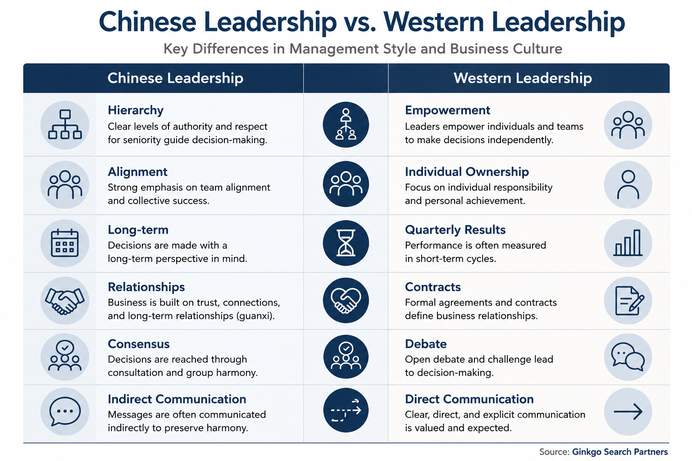
Compared with many Western organizations, Chinese companies often maintain clearer reporting structures and stronger respect for seniority. Leaders are expected to provide direction and guidance, while employees generally place greater emphasis on alignment and collective success than on individual autonomy.
However, it would be a mistake to assume that modern Chinese leadership is simply authoritarian or hierarchical. China's most successful companies have demonstrated that strong leadership can coexist with innovation, entrepreneurship, and organizational agility.
Chinese leadership today is best understood as a combination of traditional values and modern business pragmatism. While hierarchy remains important, performance, adaptability, and execution increasingly define leadership success.
Beyond Confucianism: The Evolution of Chinese Leadership
Although Confucianism remains the cultural foundation of leadership in China, modern Chinese executives are influenced by a much broader set of forces. Decades of economic reform, international expansion, overseas education, and digital transformation have reshaped leadership expectations. Today's successful Chinese executives combine respect for hierarchy with entrepreneurial thinking, faster decision-making, and a strong focus on innovation. Rather than replacing traditional leadership values, these developments have created a hybrid management style that balances cultural continuity with global competitiveness.
How Chinese Leadership Differs From Western Management Models
One of the most frequently discussed aspects of Chinese leadership is the role of hierarchy.
Many Western management models emphasize empowerment, delegation, and decentralized decision-making. Managers are often encouraged to provide strategic direction while allowing employees significant autonomy in how objectives are achieved.
Chinese organizations have traditionally placed greater emphasis on alignment, coordination, and clear accountability. Leaders are expected to provide guidance and maintain organizational cohesion while ensuring that teams remain focused on common objectives.
At the same time, modern Chinese companies have become remarkably agile. Organizations operating in highly competitive sectors often make decisions faster than their Western counterparts and adapt quickly to changing market conditions.
Rather than viewing Chinese leadership as hierarchical and Western leadership as entrepreneurial, it is more accurate to recognize that many successful Chinese executives combine centralized strategic direction with highly flexible execution.
Chinese Leadership vs Western Leadership
While every organization is different, the following comparison highlights some of the most common leadership tendencies found in Chinese and Western organizations. These are general patterns rather than absolute rules, and many global companies successfully combine elements of both leadership styles.
Key Characteristics of Successful Chinese Leaders
China's business environment has become one of the most competitive in the world. As a result, many successful Chinese executives have developed leadership characteristics that are particularly valuable in fast-changing markets.
Execution Speed
Chinese companies frequently operate in markets where product cycles are shorter, competition is intense, and customer expectations evolve rapidly. Leaders are expected to make decisions quickly and execute with urgency.
One of the defining characteristics of many successful Chinese organizations is their exceptional speed of execution. While strategic decisions are often made centrally, implementation can be remarkably fast once alignment has been achieved. Teams move quickly, resources are mobilized efficiently, and execution is typically coordinated across functions.
This ability to combine centralized strategic direction with operational agility has become a significant competitive advantage for many Chinese companies competing in industries such as electric vehicles, advanced manufacturing, artificial intelligence, and consumer technology.
Adaptability
Business conditions in China can change rapidly due to technological innovation, regulatory developments, or shifting consumer preferences. Successful leaders demonstrate a high degree of flexibility and learning agility.
Long-Term Thinking
While Chinese companies are often associated with speed, many leaders simultaneously maintain a strong long-term perspective. Strategic investments, market positioning, and relationship building are frequently evaluated over extended time horizons.
Organizational Alignment
Chinese leaders often invest significant effort in ensuring that teams move in the same direction. Strong alignment can accelerate execution and reduce organizational friction.
These characteristics have contributed to the success of companies such as Huawei, BYD, Tencent, Alibaba, and many of China's emerging technology leaders.
Chinese Leadership in the Age of Innovation
The rapid rise of Chinese technology companies has fundamentally changed international perceptions of Chinese leadership. Organizations such as BYD, Huawei, CATL, Tencent, Alibaba, and ByteDance have demonstrated that Chinese management is no longer associated primarily with manufacturing efficiency but increasingly with innovation, digital transformation, and global competitiveness.
While traditional leadership values such as hierarchy, long-term orientation, and collective responsibility remain influential, younger executives increasingly embrace entrepreneurial thinking, rapid experimentation, and data-driven decision-making. Rather than abandoning traditional management principles, modern Chinese leaders combine cultural stability with exceptional organizational agility.
The Role of Relationships and Trust in Chinese Business
Relationships continue to play a central role in Chinese business leadership.
The concept of guanxi—the cultivation of trusted personal and professional relationships—remains highly relevant in the Chinese business environment. Successful leaders invest significant time in building networks both inside and outside their organizations.
Guanxi extends beyond networking. It represents a long-term system of mutual trust, credibility, and reciprocal support. Building strong relationships with employees, customers, suppliers, regulators, and business partners remains one of the defining characteristics of successful leadership in China. Trust is established gradually and maintained through consistent actions rather than contractual obligations alone.
Trust is rarely established through a single meeting or transaction. Instead, long-term relationships are built through consistent interaction, reliability, and mutual benefit.
For multinational companies in China, this means that business development, stakeholder management, and talent acquisition often require a longer-term perspective than many executives may be accustomed to in Western markets.
Leaders who understand the importance of relationship building are often better positioned to navigate complex business environments, retain key talent, and establish sustainable partnerships.
Leadership and the Chinese Business Environment
Another important distinction is the relationship between business and the broader policy environment.
While Western companies may often operate with relatively limited government involvement, Chinese businesses operate in a context where policy priorities, industrial strategies, and regulatory developments can significantly influence business outcomes.
Successful Chinese executives therefore tend to pay close attention to economic, political, and social developments. Understanding policy direction is often viewed as an important leadership capability rather than simply a government affairs function.
For global executives leading teams in China, awareness of the broader business environment has become increasingly important for strategic planning and decision-making.
Communication, Trust, and Maintaining Face
Communication styles also differ significantly between China and many Western countries.
Western executives often value direct communication and open debate. In contrast, Chinese leaders frequently place greater emphasis on maintaining harmony, preserving relationships, and avoiding unnecessary confrontation.
As a result, communication can sometimes be more indirect than foreign executives expect. Disagreement may be expressed subtly, and consensus-building often takes place behind the scenes before formal decisions are announced.
This approach is closely linked to the concept of preserving "face"—maintaining personal dignity, reputation, and respect within professional relationships.
The concept of saving face also influences leadership communication on a daily basis. Constructive feedback is often delivered privately and diplomatically to preserve dignity and maintain harmonious working relationships. Likewise, disagreement is frequently expressed indirectly, requiring international managers to pay close attention to context, tone, and non-verbal communication rather than relying solely on explicit statements.
International executives who recognize these communication dynamics are often more effective at building trust, strengthening relationships, and avoiding misunderstandings.
Leadership Challenges for Multinational Companies in China
Many multinational companies underestimate the extent to which leadership effectiveness in China requires local adaptation.
Executives who have been highly successful in Europe or North America do not automatically achieve the same results in China. Differences in organizational culture, communication styles, talent expectations, and decision-making processes can create unexpected challenges.
As a result, companies increasingly seek leaders who can bridge global strategy and local execution. These individuals combine international business experience with a deep understanding of the Chinese market, local stakeholders, and cultural dynamics.
The ability to operate effectively across both global and local contexts has become one of the most sought-after leadership capabilities in China.
Building Leadership Teams in China
For multinational companies, understanding Chinese leadership is only part of the challenge. Equally important is the ability to identify, attract, and develop leaders who can succeed in China's increasingly competitive business environment.
Many organizations initially focus on technical expertise, industry experience, or international exposure when hiring senior executives in China. While these factors remain important, they are rarely sufficient on their own.
The most successful leaders in China typically combine several capabilities. They understand local market dynamics while remaining aligned with global corporate objectives. They can navigate complex stakeholder environments, build trust across cultures, and translate strategy into execution. Most importantly, they are able to operate effectively in both local and international business contexts.
One of the key leadership decisions facing multinational companies is determining the right balance between local and international talent. In the past, many organizations relied heavily on expatriate executives to lead their China operations. Today, however, an increasing number of companies are appointing local Chinese leaders to senior management positions.
This shift reflects the growing sophistication of China's leadership talent pool. Many Chinese executives have gained extensive experience working for multinational corporations, managing international teams, and operating in global markets. Their understanding of local customers, regulators, business partners, and talent markets often provides a significant competitive advantage.
At the same time, leadership succession has become a growing priority. As business conditions become more complex, companies can no longer rely solely on external hiring to fill critical leadership positions. Building internal leadership pipelines, identifying high-potential managers, and investing in leadership development are becoming essential components of long-term success in China.
Organizations that consistently outperform their competitors are often those that treat leadership as a strategic asset rather than a recruitment exercise. They invest in leadership assessment, succession planning, and talent development long before a leadership gap emerges.
Ultimately, the challenge is not simply finding executives for China. It is building leadership teams that can bridge global strategy and local execution, navigate uncertainty, and create sustainable competitive advantage in one of the world's most dynamic markets.
Looking for Executive Leaders in China?
Finding leaders who can bridge Chinese business culture and international management expectations requires more than traditional recruitment. At Ginkgo Search Partners, we specialize in executive search for multinational companies hiring senior management teams across China.
→ Learn more about our Executive Search services.
What International Companies Should Look for When Hiring Leaders in China
Having interviewed, assessed, and recruited hundreds of senior executives across China over the past decade, we have observed consistent leadership characteristics among the executives who achieve the greatest long-term success in multinational organizations.
Based on our executive search experience in China, the most successful executives combine strong commercial leadership with cultural intelligence. Technical expertise and international management experience remain important, but they are rarely sufficient on their own. Effective leaders understand how to build trust across cultures, navigate hierarchical organizations, communicate effectively with local stakeholders, and lead multicultural teams through periods of rapid change.
For multinational companies, hiring leadership talent in China is therefore not simply about identifying the most experienced executive. It is about selecting leaders who can successfully bridge Western corporate governance with the realities of the Chinese business environment.
What Global Executives Need to Know About Leading in China
The most successful multinational companies in China increasingly recognize that leadership effectiveness cannot be assessed solely through Western management frameworks.
Many of China's strongest executives combine qualities that may initially appear contradictory: long-term thinking and rapid execution, strong hierarchy and entrepreneurial agility, collective alignment and personal accountability.
As China's business environment continues to evolve, companies require leaders who can navigate complexity, build high-performing teams, and respond quickly to changing market conditions.
Understanding Chinese leadership is no longer simply a matter of cultural awareness. For multinational companies operating in China, it has become a strategic capability that directly influences hiring decisions, leadership development, organizational effectiveness, and long-term business success.
The future of business in China will not be shaped solely by technology, capital, or market access. It will be shaped by leadership.
RELATED INSIGHTS
