
8 min read | First published: 2018 | Last updated: July 2026
China's automotive industry has undergone one of the most significant transformations in modern manufacturing.
Over the past decade, the country has evolved from the world's largest automotive production base into one of the industry's leading centres for electric mobility, intelligent vehicles, software development, battery technology, and artificial intelligence. Today, innovation increasingly originates in China rather than being adapted for the Chinese market.
This transformation is changing not only how vehicles are designed and developed but also how automotive companies build leadership teams.
Chinese automotive manufacturers are accelerating their international expansion while multinational companies are giving their China-based engineering organisations greater global responsibility. As a result, leadership requirements are evolving rapidly, creating growing demand for executives who can combine technical expertise with international management experience and cross-cultural leadership capabilities.
From Manufacturing Excellence to System-Level Innovation
For many years, China's competitive advantage was associated primarily with manufacturing scale and cost efficiency.
Today, the industry competes on very different strengths.
Software-defined vehicles, artificial intelligence, intelligent driving systems, connected vehicle ecosystems, battery innovation, and rapid product development have fundamentally reshaped the competitive landscape. Chinese manufacturers have demonstrated an exceptional ability to move new technologies from concept to commercial production within remarkably short development cycles.
Independent industry research increasingly confirms China's growing role as a global automotive innovation leader. In the 2026 AutomotiveINNOVATIONS Report published by Germany's Center of Automotive Management (CAM), BYD ranked as the world's most innovative automotive manufacturer for the first time since the study began in 2005, ahead of Volkswagen and Mercedes-Benz. Three Chinese automotive groups ranked among the global top six, highlighting China's growing leadership in vehicle software, electrification, and integrated mobility technologies.
Equally important is China's highly integrated automotive ecosystem. Vehicle manufacturers, battery producers, semiconductor companies, software developers, suppliers, and technology companies collaborate far more closely than in many traditional automotive markets. This enables faster decision-making, shorter innovation cycles, and more efficient product development.
The report also highlights that Chinese manufacturers combine technological breadth, efficient development processes, and highly integrated supply chains. Together, these capabilities enable significantly faster product development than many traditional automotive organisations, fundamentally reshaping global automotive competition.
As automotive competition increasingly shifts from individual vehicle components to complete mobility ecosystems, leadership requirements are becoming considerably more sophisticated.
China's Growing Role in Global Automotive Development
One of the most significant changes in recent years is the evolving role of China within multinational automotive organisations.
Historically, vehicles developed in Europe or North America were adapted for Chinese customers. Increasingly, the opposite is becoming true. China-based engineering teams are developing technologies, software platforms, electric powertrains, and complete vehicle architectures that support global vehicle programmes.
Chinese automotive companies are following a similar path. As they establish manufacturing facilities, research centres, and commercial organisations across Europe, Southeast Asia, Latin America, and the Middle East, they require leadership teams capable of operating across multiple international markets.
The challenge is therefore no longer simply building vehicles for China. It is building organisations capable of competing globally.
As China assumes greater responsibility for global vehicle engineering and technology development, organisations increasingly require leaders who can manage international engineering teams, cross-border collaboration, and global innovation programmes.
Leadership Requirements Are Changing
The transformation of the automotive industry is reshaping executive hiring.
While operational excellence remains essential, senior leaders are increasingly expected to manage complex organisations operating at the intersection of manufacturing, software, digital technologies, and global supply chains.
General Managers today require far broader capabilities than overseeing production or sales. They must build organisations, lead transformation, attract specialised talent, and balance entrepreneurial speed with effective governance.
Similarly, engineering leaders are expected to coordinate multidisciplinary teams across software, electronics, battery systems, artificial intelligence, and vehicle engineering. Commercial executives increasingly require international market development experience alongside traditional sales expertise.
Technical competence remains essential, but leadership capability has become the primary differentiator.
International Leadership Experience Creates Competitive Advantage
As Chinese automotive companies continue their international expansion, executives with global experience have become increasingly valuable.
Many organisations seek leaders who understand both international business practices and the realities of operating within China's fast-moving business environment. Executives who can build trust across headquarters and regional organisations often accelerate decision-making, improve collaboration, and reduce organisational complexity.
This does not necessarily mean recruiting expatriate executives. Many of today's most successful leaders are Chinese executives with extensive international experience gained through multinational corporations or overseas assignments. Their ability to combine local market understanding with global management expertise represents a significant competitive advantage.
Why Executive Search Has Become Increasingly Important
The evolution of China's automotive industry has fundamentally changed executive recruitment.
For executive search firms, this means that successful automotive leadership hiring increasingly requires a deep understanding of both emerging technologies and the rapidly evolving competitive landscape in China.
The most experienced automotive leaders are rarely active job seekers. They are typically leading business units, engineering organisations, manufacturing operations, or international commercial teams. Identifying and engaging these executives requires detailed market knowledge, industry relationships, and a confidential search process.
Retained executive search enables organisations to move beyond the visible candidate market by systematically identifying leadership talent across competitors, adjacent industries, and international markets.
Equally important, executive search is no longer limited to evaluating technical qualifications. Assessing leadership style, cultural adaptability, strategic judgement, stakeholder management, and organisational fit has become central to successful executive appointments.
As leadership roles become increasingly complex, reducing hiring risk is often as important as identifying qualified candidates.
Building Leadership Teams for the Next Phase of Growth
China's automotive industry continues to evolve at extraordinary speed.
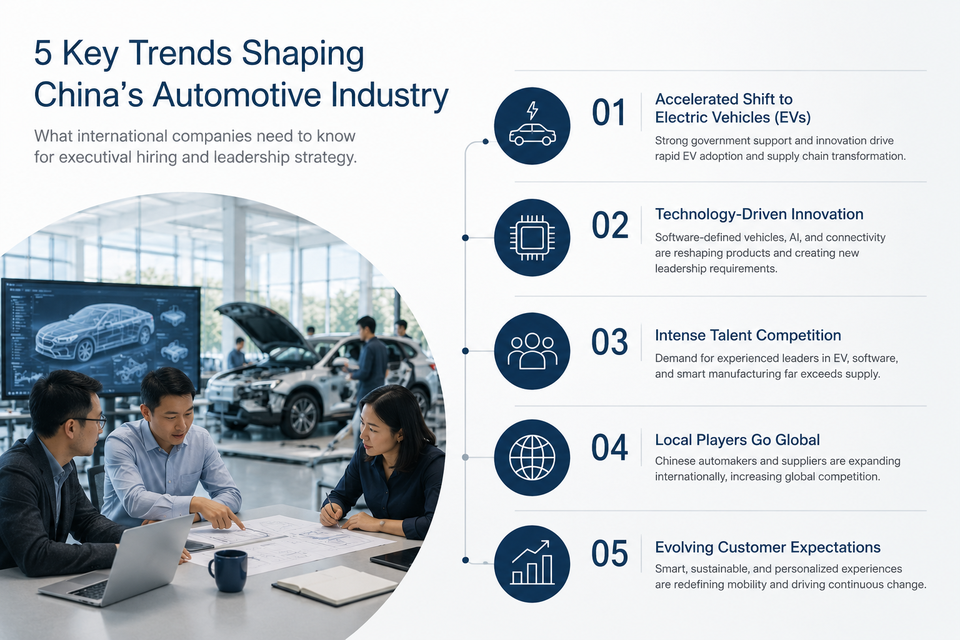
Electrification, artificial intelligence, software-defined vehicles, intelligent manufacturing, and global expansion are reshaping competitive dynamics across the industry. Organisations that successfully combine technological innovation with strong leadership will be best positioned to compete in this rapidly changing environment.
For both multinational corporations operating in China and Chinese automotive companies expanding internationally, leadership has become a strategic differentiator rather than a supporting function.
Building these leadership teams requires more than identifying experienced executives. It requires understanding how the automotive industry is changing, how leadership requirements are evolving, and how organisations can attract executives capable of creating long-term competitive advantage.
Key Takeaways
- China's automotive industry has evolved from manufacturing leadership to system-level innovation.
- Leadership requirements increasingly combine technical expertise with international management capability.
- Global expansion is driving demand for executives with cross-cultural leadership experience.
- Retained executive search enables organisations to identify and assess senior leaders beyond the active candidate market.
- As the automotive industry becomes increasingly technology-driven, leadership quality will remain a decisive competitive advantage.
